Effective January 1, 2026, New York’s statutory minimum wage is $17.00 per hour in New York City, Long Island, and Westchester County, and $16.00 per hour in the rest of New York State. On a full-time 40-hour workweek ($35,360 annual gross), a single NYC employee takes home approximately $29,678 per year or $1,141 bi-weekly after federal, state, city, and FICA taxes. For detailed rules and historical rates, consult our comprehensive NYC minimum wage guide.
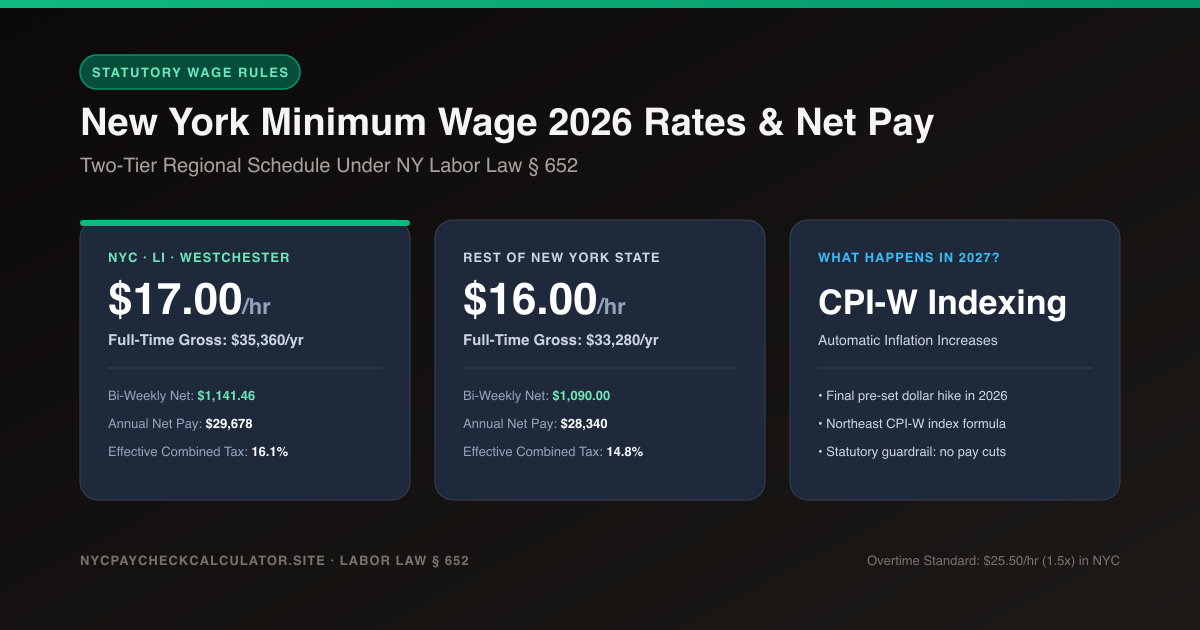
The 2026 New York Minimum Wage Map: Downstate vs. Upstate
Under legislation enacted in the FY 2024 New York State Budget by Governor Kathy Hochul and the State Legislature, New York maintains a geographic two-tier wage structure designed to account for higher regional housing and consumer costs downstate. (Compare how local taxes affect standard earnings in our NYC salary vs. take-home pay analysis).
New York Minimum Wage Rates (Effective Jan 1, 2026)
Where Does the Work Take Place?
New York wage law applies based on the physical job location, not employer headquarters or employee domicile. If an employee resides in upstate Dutchess County or New Jersey but performs work at a physical job site in Brooklyn or White Plains, the worker must be compensated at the $17.00/hr downstate rate for those hours.
What Does a $17.00/hr Minimum Wage Paycheck Look Like After Taxes?
A full-time schedule of 40 hours per week over 52 weeks equals 2,080 annual paid hours, producing a gross base salary of $35,360 in New York City. Here is how that paycheck breaks down after federal, New York State, New York City, and FICA taxes for a single filer:
| Tax / Deduction Layer | Statutory Basis | Per Bi-Weekly Check (26) | Annual Total | Share of Gross |
|---|---|---|---|---|
| Gross Earnings ($17.00/hr) | 40 hrs/wk · 2,080 hrs/yr | $1,360.00 | $35,360 | 100.0% |
| Federal Income Tax | IRS standard deduction ($15,700) | $79.35 | $2,063 | 5.6% |
| New York State Tax | NYS standard deduction ($8,000) | $50.48 | $1,312 | 2.9% |
| NYC Municipal Resident Tax | NYC progressive local brackets | $36.48 | $949 | 1.8% |
| FICA (Social Security & Medicare) | 6.2% SS + 1.45% Medicare | $104.04 | $2,705 | 7.65% |
| Net Take-Home Pay | Effective Tax Rate: 19.9% | $1,089.65 | $28,331 | 83.9% |
*Note: This standard withholding model follows our exact paycheck methodology and does not account for the federal Earned Income Tax Credit (EITC), NYS EITC, or NYC EITC. Under standard NYC 40x landlord rules, an annual income of $35,360 supports a monthly rent threshold of approximately $884—explore our NYC apartment affordability analysis and salary needed calculator to check rent feasibility.
2026 Is the Final Pre-Set Hike: The 2027 Shift to CPI-W Inflation Indexing
Since New York began phasing in $15 minimum wages in 2016, every subsequent increase was a fixed dollar amount determined directly by statute ($15.00 → $16.00 in 2024 → $16.50 in 2025 → $17.00 in 2026).
That legislative phase is now complete. Starting January 1, 2027, New York’s minimum wage will adjust automatically each year using the Consumer Price Index for Urban Wage Earners and Clerical Workers (CPI-W) for the Northeast Region, published by the U.S. Bureau of Labor Statistics.
Statutory Guardrails Under Labor Law § 652
- No Downward Adjustments: If the regional CPI-W is negative (deflation), the minimum wage cannot decrease; it remains locked at the prior rate.
- Economic Off-Ramps: Indexing pauses if the state unemployment rate exceeds 8.5%, or if non-farm total employment drops significantly over the measured period.
Special Wage Orders: Tipped Employees, Fast Food & Overtime
Not every employee receives the exact $17.00 standard rate as a direct payroll deposit. New York Department of Labor wage orders enforce specific regulations across key sectors:
Tipped Food Service
Direct cash wage: $11.35/hr. Maximum allowable tip credit: $5.65/hr. If tips plus cash wages do not reach $17.00/hr, the employer must fund the difference.
Overtime Rate (1.5x)
For non-exempt workers, any hours worked over 40 in a calendar week must be paid at 1.5 times the regular rate: $25.50 per hour in NYC, Long Island, and Westchester.
Spread of Hours
When a worker’s shift spread spans more than 10 consecutive hours (including split shifts), the employee is entitled to one additional hour of pay at $17.00.
Frequently Asked Questions: NY Minimum Wage
Key facts regarding the 2026 minimum wage laws, paychecks, and employer rules.
What is the official minimum wage in New York City in 2026?+−
As of January 1, 2026, the statutory minimum wage in New York City is $17.00 per hour for all private employers regardless of staff size. Long Island (Nassau and Suffolk counties) and Westchester County share this exact same $17.00/hr rate.
What is the minimum wage across the rest of New York State?+−
For all counties outside NYC, Long Island, and Westchester (upstate and western New York), the 2026 statutory minimum wage is $16.00 per hour, representing a $0.50 increase over the 2025 rate.
How much does a full-time NYC minimum wage worker earn annually before taxes?+−
On a standard full-time schedule of 40 hours per week (2,080 hours per year), an NYC minimum wage worker earns a gross annual salary of $35,360. Outside the downstate region at $16.00/hr, full-time gross earnings equal $33,280.
What is the after-tax take-home pay for an NYC minimum wage worker in 2026?+−
For a single filer with no pre-tax deductions, an annual gross of $35,360 yields approximately $29,678 in net annual take-home pay, or about $1,141.46 per bi-weekly paycheck. This reflects roughly $1,966 in federal income tax, $1,009 in NY State tax, $627 in NYC resident tax, and $2,705 in FICA taxes.
How does the minimum wage law apply to remote or hybrid workers?+−
Under New York Labor Law, minimum wage obligations are determined by the geographic location where the employee physically performs work, rather than where the corporate headquarters is situated. An employee residing in New Jersey or Westchester who physically works at a job site in Manhattan must receive at least $17.00/hr for those hours.
What happens to the New York minimum wage starting in 2027?+−
The 2026 increase was the final fixed statutory dollar hike passed in the 2023 state budget. Beginning January 1, 2027, annual minimum wage adjustments will occur automatically, indexed to the Northeast Consumer Price Index for Urban Wage Earners and Clerical Workers (CPI-W), ensuring future increases track inflation directly.
Can New York minimum wage be lowered if deflation occurs?+−
No. New York Labor Law § 652 includes an explicit statutory 'off-ramp' and 'no-decrease' guarantee: if the CPI-W reflects negative inflation or if the state experiences specific economic downturn conditions, the minimum wage remains frozen at the prior year's level and cannot be reduced.
What is the minimum wage for tipped food service workers in NYC?+−
In the hospitality industry, employers may claim a tip credit against the $17.00 minimum wage. Employers must pay a direct cash wage of at least $11.35 per hour, with a tip credit of up to $5.65 per hour. If direct cash wages plus customer tips do not equal at least $17.00 per hour across the shift, the employer is legally required to make up the difference.
How does overtime pay work for minimum wage workers in NYC?+−
Non-exempt minimum wage employees are entitled to overtime pay at 1.5 times their regular hourly rate for all hours worked in excess of 40 in a calendar workweek. For NYC workers earning the $17.00 baseline, the mandatory overtime rate is $25.50 per hour.
Does New York require 'Spread of Hours' pay for minimum wage earners?+−
Yes. Under the New York State Department of Labor Hospitality and Miscellaneous Wage Orders, when an employee's workday covers a spread of hours exceeding 10 hours (e.g., a split shift from 9 AM–1 PM and 5 PM–9 PM), the employer must pay one additional hour of pay at the full minimum wage rate ($17.00).